Tourism in these desperately poor environments is inevitably controversial.
On the edge of Chiang Mai, we also visited a Karen tribal community of refugees from oppression by the Myanmar military government.
Karen women are well known for their neck ornaments.
Portrait by Lukas Kroulik. (With the consent of the sitter and the community leader.)
But are these a form of mutilation?
Portrait by Lukas Kroulik. (With the consent of the sitter and the community leader.)
And is paying to visit and look at these women akin to visiting a zoo?
Portrait by Lukas Kroulik. (With the consent of the sitter and the community leader.)
Through our interpreter I was lucky enough to be able to explore their own views, and what came across more than anything else was that they wanted to continue being allowed to celebrate their beauty.
Lukas Kroulik discussing the arts and crafts of the Karen tribe people.
On our return from Bhutan we passed through Thailand and made a stop in the North where we visited two refugee communities near Chiang Mai.
This was in the Golden Triangle area, with refugees from the Chinese revolution, the Vietnam war and most recently from Myanmar.
These communities had been famous for opium cultivation which the Thai government has been able to stamp out. We visited the Queen’s Museum of Opium which featured the horrors of the trade but opium was the cash crop for these people.
The horrors of the opium trade, Museum of Opium, photo by Lukas Kroulik.
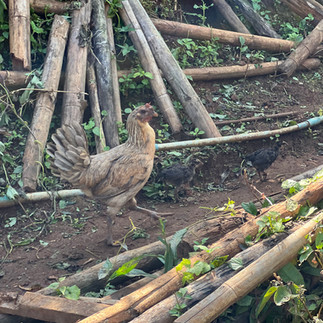
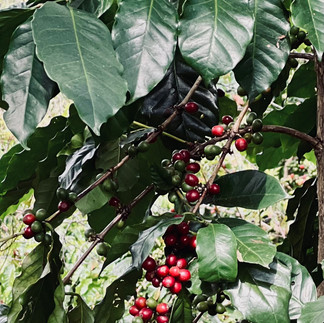
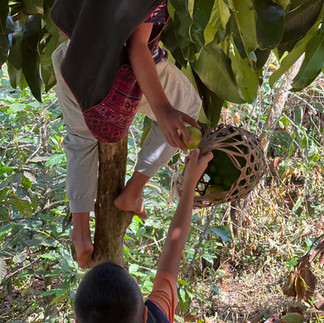
The Thai government encouraged alternatives. We found one community’s new work inspirational. In a high mountain Acah tribe village, we were hosted by the community leader who is developing a range of sustainable enterprises, some but not all related to ecotourism.
High mountain Acah tribe village, photo by Lukas Kroulik. (With the consent of the father and community leader.)
High mountain Acah tribe village, photo by Lukas Kroulik. (With the consent of the father and community leader.)
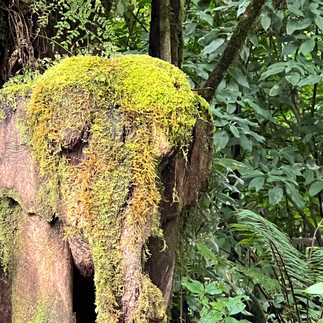
"This year, Royal Academicians Rana Begum and Níall McLaughlin have worked collaboratively and curated architecture across two galleries, alongside artworks. They have worked closely with invited architects including Boonserm Premthada, who has innovated the use of elephant dung to make bricks and is displaying a custom-designed and fabricated structure using elephant dung bricks made in the UK."
The Guardian ‘We wanted to offer a sense of hope’: architects build on the climate crisis'
Architects' Journal 'RA Summer Exhibition architecture room mixes it up – from Tracey Emin to elephant dung'
Níall McLaughlin curated architecture, including architects Boonserm Premthada, alongside artworks.
This work was on display in the Summer Exhibition 2022 in the Large Weston Room
This experience supported World Wide Fund for Nature (WWF). WWF aims to "stop the degradation of the planet's natural environment and to build a future in which humans live in harmony with nature."